
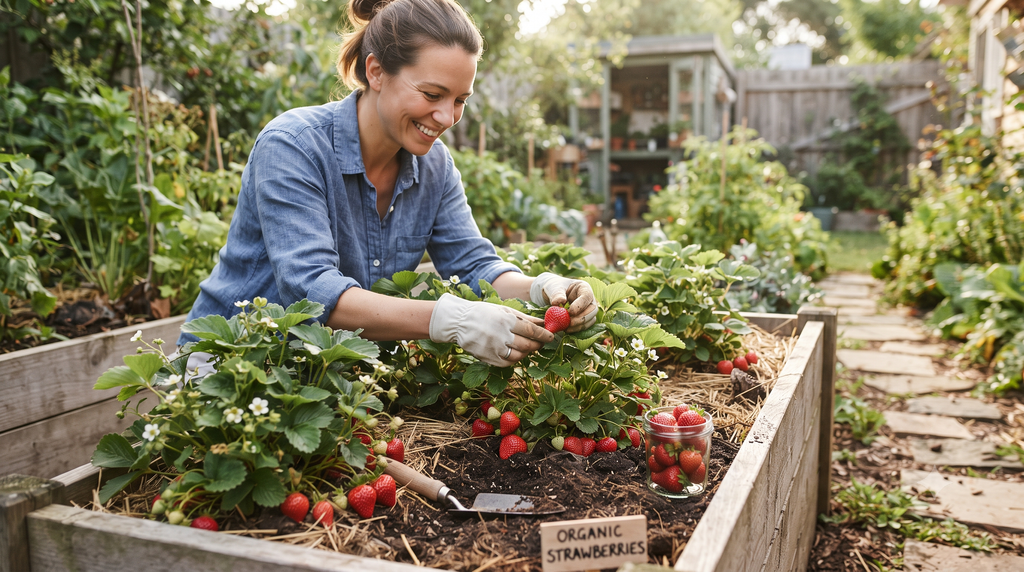
Strawberries are delicious fruits that can be grown in a home garden, balcony, terrace, or containers. With good-quality plants, fertile organic soil, enough sunlight, regular watering, and natural plant care, you can grow fresh strawberries at home.
Strawberries are especially suitable for small gardens because they do not require a lot of space.
What Is a Strawberry?
Strawberry is a small fruiting plant that belongs to the Rosaceae family. Its scientific name is Fragaria × ananassa, which is the common cultivated garden strawberry.
The strawberry plant is a low-growing perennial plant. It produces white flowers that develop into the familiar red fruit.
Interestingly, the fleshy red part that we commonly call the strawberry is not technically the botanical fruit. The small seeds visible on the surface are actually individual fruits called achenes.
Biological Classification of Strawberry
The cultivated garden strawberry is classified as follows:
| Classification | Details |
|---|---|
| Kingdom | Plantae |
| Clade | Angiosperms |
| Clade | Eudicots |
| Order | Rosales |
| Family | Rosaceae |
| Genus | Fragaria |
| Species/Hybrid | Fragaria × ananassa |
Scientific Name
The scientific name of the common cultivated garden strawberry is Fragaria × ananassa.
It is a hybrid strawberry species developed from different Fragaria species and is widely grown for commercial and home gardening.
Important Characteristics of Strawberry Plants
Strawberry plants have several useful characteristics:
- They are low-growing plants.
- They produce white flowers.
- They can produce fruits during suitable growing conditions.
- Many varieties produce runners that can develop into new plants.
- They can grow well in containers.
- They prefer fertile, well-draining soil.
Choose the Right Location
Choose a location where strawberry plants can receive around 6–8 hours of sunlight each day.
Morning sunlight is especially useful, while good air circulation helps keep the foliage healthy.
If you live in a very hot climate, some afternoon shade can help protect plants from excessive heat.
Prepare Healthy Organic Soil
Strawberries grow best in fertile, loose, and well-draining soil.
You can prepare organic soil by mixing:
- Garden soil
- Mature compost
- Well-rotted organic manure
- Cocopeat or another material that improves soil structure
Avoid waterlogged soil because strawberry roots do not grow well in continuously wet conditions.
Choose Good Strawberry Plants
For beginners, buying healthy strawberry plants or runners is often easier than growing strawberries from seeds.
Choose plants that have:
- Healthy green leaves
- Strong roots
- No visible signs of disease
- No major insect damage
Select varieties that are suitable for your local climate.
How to Plant Strawberries
Plant strawberries carefully so that the crown of the plant remains at soil level.
Do not bury the crown too deeply because this can cause the plant to rot.
Give each plant enough space for air circulation and future growth.
After planting, water gently around the base of the plant.
Growing Strawberries in Pots
Strawberries grow very well in containers.
Choose a pot or planter with good drainage holes. Hanging baskets, strawberry pots, grow bags, and regular containers can all be used.
Fill the container with fertile organic soil and place the strawberry plant so that the crown remains just above the soil surface.
Container growing is a good option for balconies, terraces, and small gardens.
Watering Strawberry Plants
Strawberries need regular moisture, especially during flowering and fruit development.
Water the plants when the top layer of soil starts to dry. Water near the base of the plant rather than frequently wetting the leaves.
Avoid overwatering because constantly wet soil can cause root problems.
Use Organic Fertilizer
Strawberries benefit from nutrient-rich soil.
You can use natural fertilizers such as:
- Mature compost
- Vermicompost
- Well-rotted organic manure
- Suitable organic liquid fertilizers
Apply fertilizer according to the plant’s needs and avoid excessive amounts.
Protect Strawberries Naturally
Strawberry plants can attract pests such as aphids, mites, caterpillars, and slugs.
Natural garden care can help protect them:
- Check leaves regularly.
- Remove damaged leaves and fruits.
- Keep the area around plants clean.
- Maintain good air circulation.
- Use suitable physical barriers when necessary.
- Remove overripe or rotting fruit quickly.
Avoid allowing damaged fruit to remain around the plant because it can attract pests.
Protect the Fruits From Soil
Strawberries develop close to the ground, so the fruit can become dirty or damaged when it rests directly on wet soil.
You can use organic mulch, such as clean straw or dry plant material, around the plants.
Mulching can help keep fruits cleaner, reduce soil moisture loss, and reduce weed growth.
When to Harvest Strawberries
Strawberries are generally ready to harvest when they have developed their characteristic color and are fully ripe.
Pick the fruits carefully with a small portion of the stem attached.
Harvest strawberries regularly rather than leaving ripe fruit on the plant for too long.
Freshly picked strawberries are best used soon after harvesting.
Common Mistakes to Avoid
Avoid these common mistakes when growing strawberries:
- Planting the crown too deeply
- Overwatering the plants
- Using poorly drained soil
- Giving plants too little sunlight
- Overcrowding strawberry plants
- Leaving rotten fruit around the plants
- Using too much fertilizer
- Ignoring pests and diseases
Benefits of Growing Organic Strawberries at Home
Growing organic strawberries at home has several benefits:
- You can enjoy freshly picked fruit.
- Strawberries can be grown in small spaces.
- They grow well in containers.
- You can use natural compost and fertilizers.
- Strawberry plants can produce runners for new plants.
- They are an attractive addition to a home garden.
Final Thoughts
Growing organic strawberries at home can be simple and rewarding. Start with healthy strawberry plants, provide fertile and well-draining soil, give them enough sunlight, and maintain regular moisture.
With proper organic care, mulching, and regular harvesting, you can enjoy fresh strawberries from your own balcony, terrace, container, or garden.