
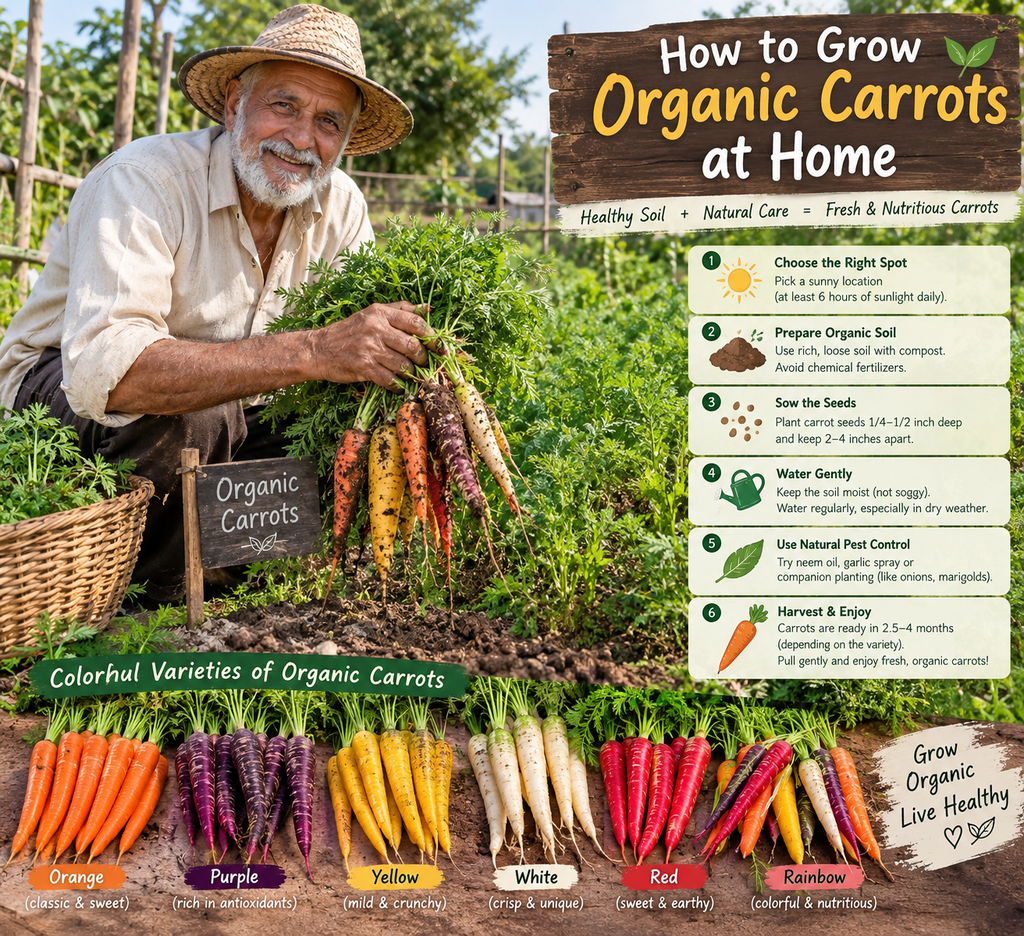
Carrots are one of the easiest root vegetables to grow in an organic home garden. They can be grown in garden beds, raised beds, and deep containers. With loose soil, good-quality seeds, regular watering, and natural fertilizer, you can grow fresh carrots at home.
Carrots are especially suitable for beginner gardeners because they do not require complicated care.
What Is a Carrot?
Carrot is a root vegetable that is mainly grown for its edible underground root. It belongs to the Apiaceae family, which also includes plants such as coriander, parsley, celery, and fennel.
The scientific name of carrot is Daucus carota.
Carrots can have different colors, including orange, purple, yellow, white, and red, depending on the variety.
Biological Classification of Carrot
The biological classification of carrot is:
| Classification | Details |
|---|---|
| Kingdom | Plantae |
| Clade | Angiosperms |
| Clade | Eudicots |
| Order | Apiales |
| Family | Apiaceae |
| Genus | Daucus |
| Species | Daucus carota |
Scientific Name
The scientific name of the cultivated carrot is Daucus carota, commonly referred to as Daucus carota subsp. sativus.
Carrot belongs to the Apiaceae family, which includes several common herbs and vegetables.
Important Characteristics of Carrots
Carrots are biennial plants that are usually grown as annual crops in home gardens. Some important characteristics include:
- The edible part is mainly the swollen taproot.
- Carrots grow best in loose and well-draining soil.
- They can be grown directly from seeds.
- They need consistent moisture during growth.
- Different varieties produce different root shapes and colors.
- They grow well in deep containers.
Choose the Right Location
Choose a sunny location where carrots can receive around 6–8 hours of sunlight each day.
Carrots can tolerate some light shade, but good sunlight generally supports healthy plant growth.
If you are growing carrots in containers, place them in an open area with good sunlight and air circulation.
Prepare the Right Soil
Soil is especially important when growing carrots because the roots need enough space to grow downward.
Use loose, fine, and well-draining soil. Remove stones, large pieces of wood, and hard soil clumps before planting.
You can prepare organic soil by mixing:
- Garden soil
- Well-rotted compost
- Cocopeat
- A small amount of organic manure
Avoid adding too much fresh manure because it can encourage excessive root branching and affect carrot shape.
Choose Good Carrot Seeds
Select fresh, good-quality carrot seeds from a reliable source.
Choose a carrot variety according to the space available in your garden. Short or round varieties can be useful for containers, while longer varieties need deeper soil.
How to Plant Carrot Seeds
Carrots are normally grown directly from seeds because their delicate roots do not transplant well.
Make shallow rows in the soil and sow the seeds about 0.5–1 cm deep. Cover them lightly with fine soil.
Keep the soil consistently moist until the seeds germinate.
Carrot seeds can take around 1–3 weeks to germinate, depending on temperature, soil moisture, and seed quality.
Thin the Seedlings
Once the seedlings appear, they may be growing too close together.
Carefully remove some weaker or overcrowded seedlings so the remaining plants have enough space to develop their roots.
Proper spacing helps carrots grow straighter and reduces competition for nutrients and water.
Watering Carrot Plants
Carrots need consistent moisture, particularly during germination and root development.
Water gently when the soil begins to dry. Avoid both extremely dry soil and waterlogged conditions.
Uneven watering can sometimes result in poor root development or cracking.
Use Organic Fertilizer
Carrots do not require excessive fertilizer. Too much nitrogen can encourage leafy growth instead of healthy roots.
Before planting, mix mature compost into the soil. If needed, use a small amount of well-rotted organic fertilizer during the growing season.
Good soil preparation is usually more important than heavy feeding.
Protect Carrots Naturally
Carrots can be affected by various pests and diseases. Regularly inspect the plants and keep the growing area clean.
Natural ways to protect carrots include:
- Remove damaged plant material.
- Avoid overwatering.
- Maintain good soil drainage.
- Keep weeds under control.
- Rotate crops when possible.
- Use physical barriers or suitable natural pest-control methods when necessary.
Healthy soil and proper spacing can help reduce many common problems.
Growing Carrots in Containers
Carrots can grow successfully in containers if the container is deep enough.
Choose a container with good drainage and enough depth for the selected carrot variety. Fill it with loose, stone-free organic soil.
Short-rooted varieties are generally easier to grow in containers because they need less soil depth.
When to Harvest Carrots
Carrots are usually ready to harvest when their roots have reached a suitable size for the variety.
Gently loosen the soil around the root before pulling the carrot. This reduces the chance of breaking the root.
Harvesting time can vary depending on the variety and growing conditions. Check the seed packet for the expected maturity period.
Freshly harvested carrots can be washed and stored properly for later use.
Common Mistakes to Avoid
Avoid these common mistakes when growing carrots:
- Using hard or compact soil
- Planting seeds too deeply
- Overcrowding seedlings
- Overwatering the soil
- Using too much nitrogen fertilizer
- Growing long-rooted varieties in shallow containers
- Allowing weeds to compete with young plants
Good soil preparation and regular care can make carrot growing much easier.
Benefits of Growing Organic Carrots at Home
Growing carrots organically at home has several benefits:
- You can enjoy freshly harvested carrots.
- They can be grown in containers or garden beds.
- Carrots require relatively simple care.
- You can use natural compost and organic soil amendments.
- Different carrot colors and varieties can be grown at home.
- They are a useful crop for beginner gardeners.
Final Thoughts
Growing organic carrots at home is simple when you provide the right soil and growing conditions. The most important step is preparing loose, deep, and well-draining soil so the roots can develop properly.
Choose good seeds, sow them directly, maintain consistent moisture, thin the seedlings, and use mature compost instead of excessive fertilizer. With patience and regular care, you can harvest fresh and healthy carrots from your own garden or container.
SEO Details
SEO Title: How to Grow Organic Carrots at Home – Complete Beginner Guide
Meta Description: Learn how to grow organic carrots at home, including carrot classification, soil preparation, seeds, watering, organic fertilizer, container growing, and harvesting.
Focus Keyword: Grow Organic Carrots at Home
Secondary Keywords: Organic Carrot Gardening, Carrot Plant Care, Growing Carrots in Containers, Carrot Biological Classification, Organic Vegetable Gardening
Suggested Featured Image: A realistic natural garden photograph showing fresh orange carrots growing in loose dark soil, with green carrot leaves above the soil, a few harvested carrots nearby, and soft natural daylight.